
Wind Turbine Converter Cooling
Keep the power electronics at full output

Elevating global standards with exceptional, unmatched Dutch craftsmanship in advanced industrial heat exchange.

What is Wind Turbine Converter Cooling?
Wind turbine converter cooling removes the heat that the power converter produces while it turns the variable output of the generator into grid-quality power. The converter switches thousands of amperes through IGBT modules, and roughly 2 to 3 percent of the power that passes through it is lost as heat. On a modern multi-megawatt turbine, that is tens of kilowatts of heat in a compact cabinet, every hour the turbine runs.
Most converters are cooled by a closed water-glycol circuit. The coolant picks up the heat at the cold plates under the power modules and carries it to a liquid-to-air cooler, usually on the nacelle roof or at the tower base, where it is released to the outside air. If that cooler loses capacity, the converter limits its own output to protect the modules. ICARUS designs and builds the glycol heat exchangers and air coolers that keep this circuit at the right temperature.
Dutch excellence in heat exchange
At ICARUS Industrial, we blend Dutch craftsmanship with innovative technology, redefining the gold standard for industrial heat exchangers. Dive into the future of sustainable manufacturing, where our Dutch-engineered solutions elevate energy efficiency to unparalleled heights.
Lower total cost of ownership (TCO)
We go beyond performance with our heat exchangers, sculpting an unbeatable blend of.
Direct manufacturer benefits
Your unique needs are our command. We offer tailored heat exchanger solutions.
Customized solutions
With ICARUS Industrial, you're not just buying a product, you're engaging a partnership. Our direct sales model
Superior durability
Built from robust materials, our heat exchangers are a testament to resilience. They reduce maintenance
Converter Cooling Solutions from ICARUS
The converter is one of the most temperature-sensitive components in a wind turbine. Its cooling loop has to hold a fixed coolant inlet temperature on the hottest day of the year, at full load, after years of dust, insects and salt on the cooler surface. ICARUS engineers each cooler for that worst case, as part of the complete wind turbine cooling system.
Liquid-to-Air Converter Coolers
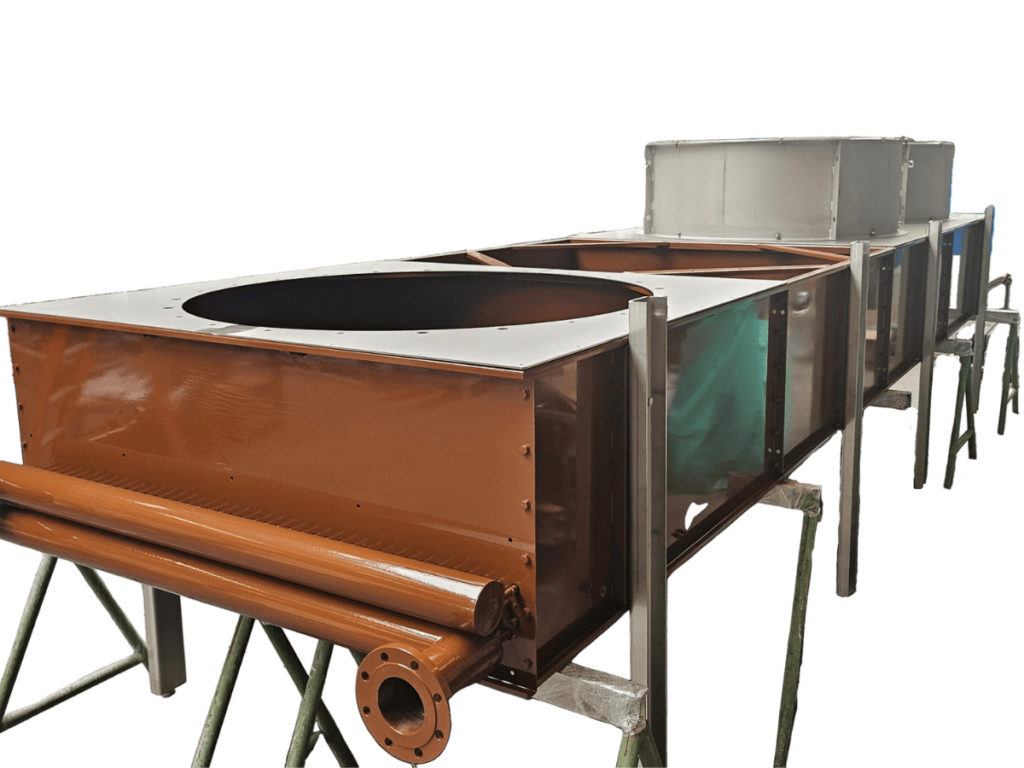
The liquid-to-air cooler is the heart of the converter cooling loop. Warm water-glycol from the converter flows through finned tubes while fans push ambient air across the coil. ICARUS sizes the coil for the converter heat load, the coolant flow and the maximum coolant inlet temperature that the converter supplier allows, at the highest ambient temperature on site. We optimize tube rows, fin pitch and circuiting for a low pressure drop on both sides, so the pump and fans use as little auxiliary power as possible. The same finned tube technology is used in our dry coolers for industry and offshore.
Converter Cabinet Air Coolers
Not all heat leaves through the cold plates. Capacitors, chokes, busbars and control electronics warm up the air inside the converter cabinet. A compact air-to-liquid coil inside the cabinet, connected to the same water-glycol circuit, removes that heat without opening the cabinet to nacelle air. For turbines without a liquid circuit, an air-to-air heat exchanger keeps the cabinet sealed while still using outside air for cooling. Both concepts protect the electronics against dust, moisture and salt.
Nacelle or Tower Base Installation
Depending on the turbine platform, the converter sits in the nacelle or at the bottom of the tower, and the cooler follows it. Roof-mounted coolers often share the air stream and the fans with the generator cooler circuit, next to the nacelle heat exchanger. Tower base converters typically use a cooler mounted on the tower wall or next to the foundation. ICARUS builds both, with custom dimensions, connection positions and mounting frames, so the cooler fits the existing interfaces of your turbine.
Fouling, Corrosion and Long Service Life
Converter coolers lose capacity slowly and quietly. Dust, pollen, cottonwood seeds and insects clog the fins on onshore sites, while salt mist attacks aluminum fins offshore. Once the air side is blocked or corroded, the coolant runs hotter and the converter starts to derate on warm days. ICARUS reduces this risk with wider fin spacing where fouling is expected, cleanable coil designs and materials matched to the site: copper/aluminum, copper/copper, coated aluminum or stainless steel AISI 316. For coastal and offshore turbines we apply the same approach as our high corrosion environment heat exchangers.
Replacement Coolers for Existing Turbines
Across the United States, thousands of turbines are approaching 15 to 20 years of operation, and owners are choosing life extension and targeted upgrades over full replacement. A corroded or undersized converter cooler is one of the most cost-effective upgrades: it removes derating on hot days and prevents costly power module failures. ICARUS reverse engineers the existing cooler from drawings, photos or measurements and builds a replacement that drops into the same position and connections, often with more capacity and better corrosion resistance than the original. We deliver single units for repairs as well as series for complete fleets.

Download products reference list
Download the comprehensive product reference list for heat exchangers and cooling systems.
Request a Converter Cooler for Your Turbine Fleet
Whether you are an OEM developing a new turbine platform, an independent service provider, or an owner extending the life of an existing wind farm, ICARUS builds the converter cooler you need. As a direct manufacturer in the Netherlands, we handle thermal design, production and testing in house. Pressure parts can be designed according to ASME Section VIII or PED.
To prepare a quotation quickly, send us:
- Converter heat load (kW) and turbine type
- Coolant type and glycol percentage, flow and maximum inlet temperature
- Maximum ambient temperature and the site: onshore, coastal or offshore
- Installation position: nacelle roof, nacelle interior or tower base
- A drawing, nameplate or photos of the current cooler for replacements
- Required quantity and target delivery date
Not sure about every value? Send what you have and our engineers will help you complete the specification.
Request a quotation
Elevate your efficiency with Dutch-engineered solutions tailored for your needs. Fill out the details below, and our team will provide a personalized quote to help you harness the power of optimized energy in manufacturing. Step into the future, one quote at a time.
ICARUS Heat Exchangers
Quotation Form
Facts about ICARUS
> 27
With over 27 years in business, we’ve carved out a reputation for excellence and innovation.
> 120+
Our global presence is marked by a diverse clientele of over 120 customers worldwide.
> 850+
Moreover, our portfolio boasts more than 850 completed projects.
FAQs about Wind Turbine Converter Cooling
Why does a wind turbine converter need its own cooling system?
The power converter loses roughly 2 to 3 percent of the power that passes through it as heat, concentrated in the IGBT modules. These semiconductors have strict temperature limits, so the heat must be removed continuously. Most converters use a closed water-glycol circuit with cold plates under the modules and a liquid-to-air cooler that releases the heat to the outside air.
What happens when a converter cooler loses capacity?
The coolant temperature rises, and the converter controller reduces output to protect the power modules. Operators see this as derating on warm afternoons or as temperature alarms. If nothing is done, the modules age faster and can fail, which means a costly repair and lost production. Cleaning or replacing the cooler usually restores full output.
Can ICARUS replace the converter cooler on an older turbine?
Yes. We reverse engineer the existing unit from drawings, photos, a nameplate or measurements, and build a replacement that fits the same position and connections. Where the original cooler failed due to fouling or corrosion, we adjust the fin spacing or materials so the replacement lasts longer. Single units and fleet series are both possible.
Which materials do you use for converter coolers?
That depends on the site. Onshore coolers are typically built with copper tubes and aluminum fins. For coastal and offshore turbines we offer copper/copper, coated aluminum and stainless steel AISI 316 executions. The material is matched to the corrosion class of the site and the remaining design life of the turbine.
What information do you need to quote a converter cooler?
The key inputs are the converter heat load in kW, the coolant type, flow and maximum inlet temperature, the maximum ambient temperature, the site type and the installation position. For replacements, a drawing, nameplate or photos of the current cooler help a lot. If some data is missing, send what you have and our engineers will help you fill the gaps.


